Google, Android and Botanic meta space – the gatweway to new designs…
Author: Phil Baillie
Lovers in Guilin
Phil's Journey through Journalism

Out into the lesser known China – although very popular with Chinese tourists – Guilin is a land for couples on scooters, holidaymakers and midnight roamers.
QR technology
Phil's Journey through JournalismIf you have a smartphone – use the bar-code scanner to read this post…
Interview with CBI Wales Director David Rosser
Cardiff Business NewsRead the full article at the Cardiffian website.
Niche Blog Strategy Review
Phil's Journey through JournalismIn my niche strategy I outlined the purpose of the blog:
“To serve the business community in Cardiff, to highlight the political consequences of the spending cuts on the public. To map job losses and provide a platform for discussion on how to grow the private sector.”
Initially, I set out to achieve this by blogging about protests over spending cuts, starting a geo-tag google map of job losses and discussed issues such as business growth, entrepreneurship and online revenue. Gradually, however, I have found it beneficial to reflect on macroeconomic events and take a Cardiff angle on them.
I took an experimental approach to the blog, which has involved interviews, video coverage, weekly round-ups, data analysis, discussion and media scrutiny.
Over time, this approach resulted in a varied product, which did not conform to one particular style, although I found I particularly enjoyed interviewing Business in the Community (BITC) director Simon Harris and covering live events. The most successful posts tended to be about current affairs that affected people such as the heavy snow fall in December.
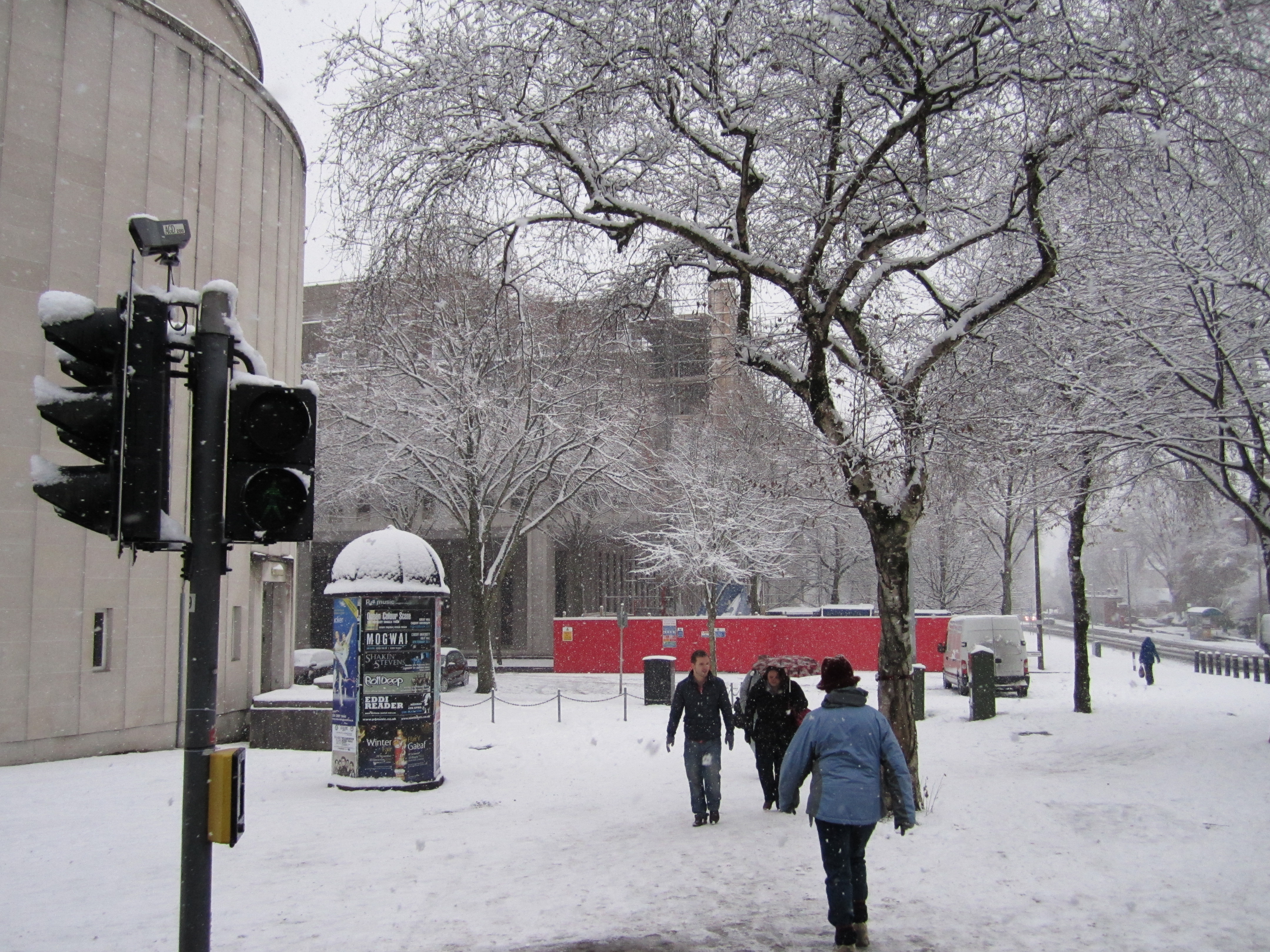
Snow brings Cardiff City Centre to a standstill
The blog site was used as a hub to incorporate the course blog and niche area as the two did overlap to a certain extent. I managed to post twice a week in the first term as planned, but have averaged around a post a week since the Christmas break. This change is mainly due to the fact that the niche blogs stopped after the end of the first semester.
I used self-generated videos and photos, but also some uploaded from youtube, embedded maps and links. The best results were achieved from uploading unique video content. I would hope to use this more in the future, as will be discussed below in the hit count analysis. Flikr was used sparingly, but Twitter was important in attracting an audience. Facebook was also useful, but attracted a different audience. SEO was important throughout as many of the posts attracted people searching for topical issues such as Egypt or the Celtic Tiger in Ireland.
The number of hits increased as momentum was maintained. A quiet period would see the number of views drop off. So I have learnt it is important to keep the blog updated on a regular basis, the more often the better. Embedded video in conjunction with facebook was successful in bringing a larger readership. One problem I found was that the readership on facebook is less business minded, and I would receive higher hit counts for articles that were more personal and less business related. Over time, the challenge would be to connect more with the business community, bringing more debates in the form of interviews to the site, to spark a string of comments.
Judging by the number of hits, self generated video content was the most successful in bringing an audience, but I found it a challenge to tap into the business community directly. More exclusive interviews would be needed to build up a larger following. A weekly business round-up would work well to provide a regular service, like an economic bulletin. Focusing on macroeconomic issues were interesting to write about but less effective in drawing readership from the business community. The analysis of macroeconomic issues was a useful exercise to explore the effects of global trends and explain them in an engaging way, but it ultimately it did not attract as many views as did raw content from the business community in Cardiff.
I think the initial proposal was ambitious and more time would be needed to build a blog to adequately serve the business community in Cardiff, although I do believe there is room for a rival to the recently launched Wales Online portal. A video based blog might work best for this.
Creating a blog has been enjoyable, and I hope to continue the project. The most effective blogging strategy, however, I think would involve gaining more exclusive content to complement reviews and reflections on financial media. This approach could be used as a template to bring to other cities to create a hyperlocal business community, maximising the use of twitter, but ultimately stemming from a well established business network to serve business people, covering the issues that affect them most.
Rising prices: hidden poverty
Cardiff Business NewsAs the UK announced the inflation rate increasing to 4%, data released by the World Bank revealed 44 million people have been thrown into poverty since last summer as a result of rising food prices.
The inflation increase made the headlines today as Mervyn King, the Bank of England Governor will be expected to write to the Chancellor of the Exchequer, George Osborne, explaining why inflation remains about the target level of 2%.
Mr Osborne, in an interview with the BBC blamed in part rising commodity prices on the increased level of inflation.
Yet the Guardian economics editor, Larry Elliott, picked up another angle on the effects of rising commodity prices, although the issue has been pressing for some time now.
Rising food prices will push more people into poverty (World Bank)
According to Index Mundi, an internet market data provider wheat prices have almost doubled year-on-year.
But how does rising commodity prices such as the price of wheat affect people on the ground?
Last week I wrote about high inflation in Egypt contributing to unrest, which is exactly what Elliot draws from Robert Zoellick, the current World Bank President in the Guardian article.
Rising commodity prices passes increased charges to importing countries, causing inflation. This means the price of products will go up to meet the cost of importing commodities and pass this on to the consumer. If wages and interest on savings do not stay in line with inflation, they are gradually eroded and relative wages fall.
But the problem of rising food prices could be exacerbated by the worst drought in China for over 60 years, according to a recent report in this week’s Economist. It writes, if China, which is traditionally self-sufficient in grains, could set wheat prices to rocket should the country start to import wheat.
As global markets are interconnected, rising prices will not only affect us in the UK (and in Wales) as we see petrol prices and food charges going up, but developing countries will be hit even harder as those with little struggle to keep up with rising prices.
Coupled with the rise in Brent crude oil, we should expect Mr King to be writing letters to the government for the foreseeable future.
Cardiff Students Launch Website
Cardiff Media BlogsFor local news, sport, politics and business in Cardiff visit The Cardiffian.
The Ripple Effect – Revolution in Egypt
Cardiff Business NewsAs protesters erupt on the streets of Cairo for the seventh day in a row, political pressure is mounting on Egyptian President Hosni Mubarak to step down after a 30 year autocratic rule.

Photo by Muhammad
While the geopolitical implications for the region are monumental (as Egypt is supported with American aid in part for its favourable relationship with Israel which could change under a new government) the dual force of inspiration from events in Tunisia and economic woe has pushed the north African country to the brink of revolution.
Live twitter feeds and video have made events exciting to watch unfold on the TV or on the laptop, listening to updates from BBC correspondent Jeremy Bowen or Channel four’s John Snow. But behind all the pictures fed through by the media much is at stake.
Dividends have failed to filter down to the Egyptian people despite the country experiencing GDP growth of over 5 per cent in 2010, meanwhile high inflation (around 12.8 per cent) and rising unemployment have caused discontent with the those in and out of work.
And now, tens of thousands of Egyptians are standing up to say they have had enough of the same.
Things may just be about to change – and Egyptians hope it will be for the better, with greater economic prosperity and greater democracy to improve their lives.
But there is one other issue I would like to investigate: do the events in Egypt affect us in the UK or indeed in Wales?
When I visited Cairo in the summer of 2010, our tour guides were predicting an uprising against Mubarak as we passed through what seemed a chaotic city centre with growing unemployment, a place where 20 per cent of the population live below the poverty line.
Of course the tourism industry will take a hit, with over 20,000 British citizens stranded in the country while others holidaymakers and business travellers have been advised by the FCO to avoid making the trip except in urgent circumstances.

Tourists have been advised against travelling to Egypt
The BBC made this clear earlier today. Meanwhile the Financial Times reported yesterday that businesses have started to evacuate staff. Investors look on nervously as shares fell in Cairo by 16% in two days last week.
Similarly, the political unrest in Egypt, which has moderate oil reserves yet its Suez canal acts as an important thoroughfare for oil and gas, have also pushed up the price of it to over $100 a barrel, which will inevitably push fuel prices up in the UK if they are sustained at this high level for any great length of time.
In fact, David Cameron on today’s BBC breakfast show hinted he could introduce a “fuel stabiliser” to help reduce prices for fuel motorists have to pay when asked about the effects of events in Egypt on fuel prices.
So while I watch updates stream through on Twitter, events unfolding in Egypt have reminded me of the importance of economic policy and geopolitics, and their impact on the lives of everyday people on the ground.
Whatever unfolds in the next few days will not only make history of or for President Mubarak, but it will send ripples through neighbouring north-African countries into OPEC, international trade, UK motorists and most importantly, the lives of everyday Egyptians.
What is Entrepreneurship?
Phil's Journey through JournalismBy the time he was 11, a London boy named Alan Sugar started his career selling rags to a scrap merchant. Although the merchant swindled the young Mr Sugar by handing him half a crown for what turned out to be wool, rather than £1.10, he was beginning to develop something known as the ‘entrepreneurial spirit’.

Can anyone replicate his success?
By the age of 15 he bought a camera and started selling pictures of children in his neighbourhood to parents and grandparents, making some extra cash on the side while studying. But to the horror of his parents he left school early to work in a factory. His story is one of rags to riches, from the back streets of Croydon to heart of London, Southbank. Today he is arguably the most iconic self-made man in the UK.
But with so much media talk of entrepreneurship – a clear ideology of the coalition government – as the “Big Society” begins a process of decentralisation and looks to create space for new business start-ups to take the flack of the recession, it has made me question, what does it mean to be “entrepreneurial”? And is it the way forward?
Just two days ago at the Cardiff business club, another celebrity entrepreneur and politican Lord Heseltine spoke of his journey to success in his early days after graduation from Oxford. Of course he faced uncertainty. He had to start out somewhere, eventually becoming one of the most successful publishing moguls of our time. Lord Heseltine said he started out with £1000 in his pocket and began his entrepreneurial journey by renting a 9 bedroom flat with a friend and letting it out for a small profit. The pair then moved their business into a hotel. A snowball effect culminating in the genesis of Haymarket with a friend from university.
What can we learn about entrepreneurship from these two men? The lesson I took was to make the most of a little. There were many times when projects failed. Heseltine’s magazines, <emMan about town and Topic were a flop and Lord Sugar nearly lost his fortune with the demise of Amstrad. But persistence, resilience and some luck managed to pull them through.
The Oxford dictionary defines entrepreneurship as characterized by the taking of financial risks in the hope of profit. But is entrepreneurship solely about taking risks and making profit? Perhaps it is about having a sense of commercial awareness, resourcefulness, energy, creativity and an understanding of one’s strengths and weaknesses. So when a spot of luck comes your way, you are ready to make the most of it. And perhaps the best outcome is to benefit society with the by-product of some profit.
Perhaps part of his success is down to the fact that he is not afraid to be himself. What you see is what you get.
2010: The death of the Tiger?
Cardiff Business NewsAS Ireland laments the death of its Celtic Tiger the Chinese are preparing to see out the year of tiger to ring in the new year of the rabbit. It seems 2010 has brought the death of the tiger, making it an endangered species in the West.

The death of the Celtic Tiger in 2010
This year finance ministers in the Eurozone have struggled to keep inflation low, ensure banks are furnished with credit and balance the demands of taxpayers against investors. With all the talk of cuts and austerity, what has got us in this mess, and what does 2011 hold for Western Economies?
European Bailouts
The Eurozone has had a rocky time. In May the IMF and the European Union announced a support package for Greece to the tune of 120bn euro. In November the same pair had to come to the rescue in Ireland with an 85bn euro package, despite the country’s initial denial that it needed any help. Fears of contagion in the Eurozone have not yet been quashed as some investors anticipate bailout deals for the Iberian peninsula.

The Irish banks will get around 11bn euro from the European Financial Stability Mechanism (EFSM)
Austerity
For much of the developed western world it has been a year of austerity with spending cuts, tax hikes, bank bailouts, quantitative easing and emergency summits. The UK’s coalition government announced its comprehensive spending review in October, passing the buck (certainly not literally) to regional governments. Next year VAT, a consumption tax, will rise to 20% while spending cuts in the public sector will mean around 330,000 public sector workers will lose their jobs.
Go East
“Go East young man” has been the motto of the middle class with increasing numbers of investors and students looking for better job prospects and growth in Asia. Meanwhile the Euro crisis has prompted a move by the Chinese government to pour capital into the west by buying European bonds to ensure European financial stability.
The Welsh View
As for Wales – The Ryder Cup may have brought much international attention in 2010, but in terms of the economy, Wales has received very little good news of late. The office for national statistics released data last month revealing Wales as the poorest nation in the UK. And with an workforce heavily reliant on the public sector, a drive in the private sector may be hampered by poor technological infrastructure.
Reasons to be cheerful
While there has been much doom and gloom in the past year there are still some reasons to be positive for 2011. Wales is set to cash in on London 2012 as it will host 14 football matches and be used as a training base before the games by some international teams. It has never been easier to start a business, with a boom in online start-ups and the Cardiff Bay development has brought life to the Welsh capital. One indicator we will all be watching with anticipation is GDP, as the CBI has predicted 2% growth for the UK economy in 2011.
In Europe it is yet to be seen whether the ECB issues e-bonds or will increase the EFSM to stabilise markets.
Let’s just hope there is not a double dip recession, turning the year of the tiger to the year of the Bear.
 Philip Baillie's web portal