Q & A: What does the Draft Budget mean for Wales?

Cardiff Business News

It has been called the biggest challenge to the WAG since the advent of devolution. But what is the budget and what does it actually mean for the people of Wales?

What is the Draft Budget?

It is a draft of spending plans for Wales over the next three years. Each year the WAG is allocated funding, for example, £13.5bn was set aside for revenue spending and £1.2bn for capital spending in 2011-12.

Why is it important?

The draft budget outlines the amount of expenditure available to government departments, including Health and Social Services, Social Justice and Local Government, Economy and Transport, Environment Sustainability and Housing, Rural affairs, Heritage, Public Services and Performance and Central Services and Administration. There will be cuts to all of these sectors, which will lead to departmental cost cutting measures including possible redundancies.

How much and what is going to be cut?

The total capital expenditure, that is, the amount available for building projects such as schools, roads and hospitals will be cut by around 33% over the next four years.

captial

Meanwhile the total revenue expenditure, which relates to running costs such as salaries, will be cut by around 7%, meaning the total budget will be cut by 40% over the next three years.

revenue change

Source WAG draft budget

What has been saved?

There will still be free breakfasts for children at school, free prescriptions for those on low incomes, concessionary travel for the elderly and disabled and free swimming.

What will the spending cuts mean for the private sector?

While the draft budget gives an indication of how cuts will be administered to the public sector, there will also be ramifications for the private sector.

impact

Cuts to the public sector will mean contracts to private companies will be curtailed as building projects are frozen, and this draft budget will no doubt concern businesses in Cardiff.

Ok, but it’s only a draft budget. When does it become official?

Assembly votes on the final budget on February 8.

The Draft Budget can be viewed in full on the Welsh Assembly Government website
The Source Guide: Business Blogs in Cardiff

Cardiff Business News

Businesses in Cardiff
A membership club for local businesses in Cardiff

A Blog for start-ups
A website offering advice to new start-up companies in Wales

South Wales Business News
Business from the South Wales area – written by four local entrepreneurs

Devolution Matters
A political blog on Wales

Wales Online Business News
News from the Business scene in Wales

Save the Basics

Cardiff Media Blogs

News may be changing – but the basic skills of journalism are not.

Rory Cellan-Jones, a Business Journalist who started out at Wales Online in 1983, told JOMEC students about the fast changes taking place in the news industry last week.

Despite unprecedented changes to the news industry, he said the core skill set in journalism will remain the same. The ability to to turn pieces around in a hurry and solid logistic skills with a thirst for accuracy are essential to the trade.

Added to this are the new pressures of being able to write for new platforms such as twitter, interacting with more readers online and understanding copyright law for the likes of flikr and facebook.

And just as we thought things were challenging enough, he said there must be an allowance to experiment with technology such as online video editing, audioboo, blogging and SEO.

Because a new relationship with technology means that we will now have a new relationship with the audience.

New technology and the democratisation of information may also have an effect on business and financial matters.

There is the possibility, for example, that sensitive financial information could be leaked onto the internet, which could in turn, affect share prices if the blogs prove to be trustworthy.

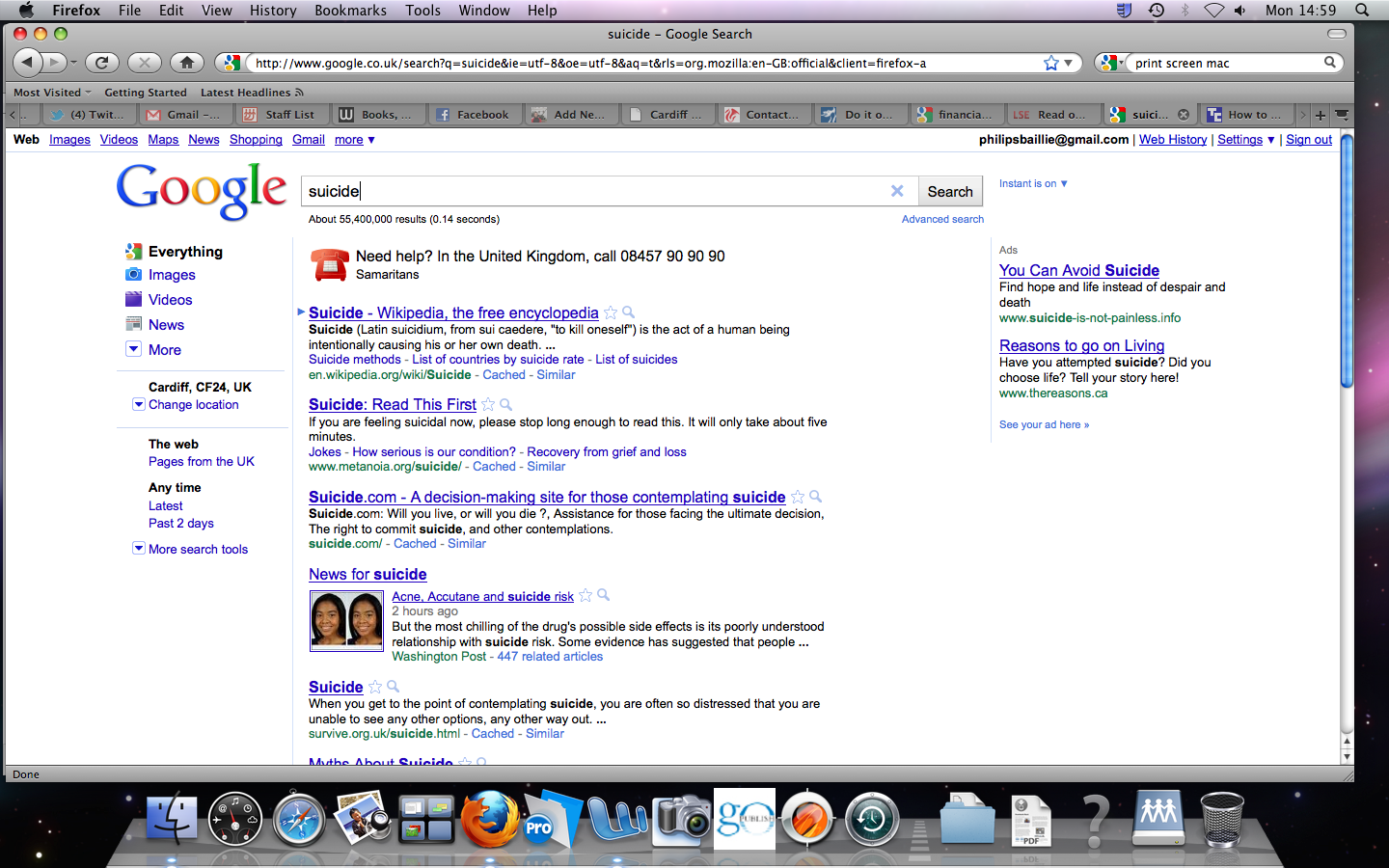
Mr Cellan-Jones also highlighted the fact that the status of Google as a non-involved media engine is continually being questioned.

The number for the charity group ‘Samaritans’ is shown when a search is made for the term ‘suicide’.

Google TV is a major new development that will change the way we consume visual media. People may no longer look to watch TV on channels, but snippets of their favourite show.

So as technology beings to blur the boundaries of journalism, the new generation of journalists must strive to focus on the basics, to save the trade from deterioration of hard news skills and to inform the world of what is going on in an accurate and balanced manner.

Citizen Auditing

Cardiff Business News

We have all heard about the rise of citizen journalism since the creation of the blogosphere.

But with David Cameron’s recent announcement of a new transparency mechanism for the publishing of departmental business plans, we could just see a new form of citizen accountability: Citizen Auditing.

The Prime Minister said yesterday: “We’re shining a bright light of transparency on everything government does.”

Yet the transparency website is more a checklist than a comprehensive set of data.

But here is the list of DEL spending for each department.

It means we know that we should expect large cuts in departmental over the next 4-5 years. As the figures do not take account of inflation so many of the departments will not grow in real terms.

The department for skills and innovation, for example, will see its budget cuts by £4bn over the next four years.

A Labour of Love

Cardiff Media Blogs

Writing is a labour of love.

Many of us would love to write, think and create – and journalists are in a privileged position that allows them to get paid to do so.

But Journalism is also a business.

Adam Tinworth, a business journalist, reminded JOMEC students of this fact, and posed some challenging questions to the room, most of whom have paid to enter into an industry where passion is paramount to success.

But is the business really crumbling as a media panic suggests? And if so, what are we going to do about it?

First there are a couple of myths to bust.

“No one makes any money online.”

This is not true.

There is what Mr Tinworth described as “The triple”

1) Data – Selling information that helps people to do their day job better
2) Events – including interaction with readers online
3) Advertising – online revenue created through targeted advertising

Money is made at Reed Business Information, the company where Mr Tinworth is head of Blog development, by implementing a paywall for their data set as he says a paywall for journalistic pieces is unworkable.

His argument is that people will find free, trusted blogs about their subjects rather than pay for journalistic pieces, but data is sacred.

It prompts the question – is there an equivalent of “data” in the news industry?

Perhaps a trusted brand, or news sense is what people would be prepared to pay for – or a platform where they can engage and be recognised.

Surely anyone with a successful blog and a passion for their subject could start such a following. So that’s it, it’s about the passion, the love for a topic or a subject that will not only ensure that content is entertaining, but useful and beating everyone else in the race to publish. Such blogs, should be essential for anyone in the industry so much so that it becomes a “home page”.

There is a second myth.

“Blogging is all about opinion.”

Again, not true.

Blogging is about conversation. As everyone can publish the characteristics of publishing can change.

According to Mr Tinworth Blogging can be about sharing interesting stuff with other people. It is also about interaction people will want to talk about that interesting topic.

Then there is the aspect of accuracy. As people are now able to “talk back” the journalist, there is less room for error.

If this is achieved, the blog becomes an attracting force for forms of revenue. An audeince forms, and the basic technique of maintaining a beat holds for the blogosphere. But for the basics, a blogger has to be inquisitive, honest, communicative, enthusiastic and informed.

So what about journalists and newspapers? Do they have a future?

The future of journalism is tied to its business model.

Making as many useful products that are invaluable to other people and businesses is the key. As data is sacred, Newspapers could try and find their own version of a dataset. That could be in the form of reliable news, exclusive interviews and pictures, even paywall certain sections of online content. It seems, however, that online advertising holds the key. But is online advertising effective? Here are some stats.

If we work out a viable business model journalists can continue to labour in love.

Wales and the CSR: What is to be done?

Cardiff Business News

Financial terminology has never been so in vogue as it is today.

At last, financial journalism has become recognised by a wider audience as a matter of necessity to understand what is going on in the world and why the bank won’t lend any money to Mr Joe’s business or refuses to offer a mortgage to Mrs Bloggs.

Financial jargon has become part of everyday language. In fact financial terms have been overused and abused, much to the horror of the average reader.

National debt, welfare and benefit cuts, budget deficits, currency wars, bond prices, yields, fiscal consolidation programmes, capital expenditure, quantitative easing, sub-prime mortgages, financial meltdown…I could go on. These terms have almost come into the vernacular since the onset of the financial crisis in late 2007 with technical terms appearing in newspaper articles, on TV and in the workplace. It all seems overwhelming.

However, we must wrestle with these terms to bring out some of the consequences and impacts these macro decisions have on you and I.

And this evening’s meeting in Cardiff on the impact of the Comprehensive Spending Review revealed on 20th October sought to answer some of the most important questions of how Wales will be affected by systematic budget cuts.

First Minister of Wales, Carwyn Jones, said at the meeting in Cardiff University that Wales had been disproportionately hit by the spending review.

Mr Jones told hundreds of Business leaders and students at the event that the current economic challenge left to the WAG to sort out was its biggest since devolution began 13 years ago.

He cited UK Economics Nobel Laureate, Chris Pissarides, who recently criticised government measures to cut public spending as running the risk of dropping people into poverty, adding that PWC’s recent forecast was that 50,000 public sector jobs would be lost as a result of the CSR.

He said: “These measures are not fair to Wales,” as housing benefit changes would hit poorer households more proportionately.

Meanwhile capital spending allocation will reduce by 25% this year and up to 41% over the next four years. Mr Jones also hit out at the government for neglecting development projects such as the defence training base at St Athan, the closure of the Newport passport office and other sidelined projects.

He also said the Barnett Formula, the mechanism used by the Treasury to work out the amounts of public expenditure, was flawed for Wales.

…More to follow…

Machine vs Man

Cardiff Media Blogs

‘Plan for the Machine, write for the human.’

Journalism is changing. News is being diverted from printed pages to screens and devices.

News consumers no longer sit on the bus or on the couch at home scouring pages for fresh stories. They now sit behind desks, are on the move and always connected.

This change towards online media has seen the evolution of the blog. And blogging, which can include other aspects of online communication such as tweeting or microblogging, has always been directed at an audience.

But nowadays it seems bloggers and journalists are not only writing for an audience, but also for the machine, that is, the internet.

Glyn Mottershead at Cardiff University stressed the importance of being able to be ‘found’ online by an audeince as news organisations battle it out.

But where do audiences come from?

According to infographic labs internet users turn to google as a first port of call:

Google = 84.73% market share
Yahoo! = 6.35% market share
Baidu = 3.31% market share
Bing = 3.30% market share
Ask = 0.71% market share
AOL = 0.40% market share
Other = 0.20% market share

Similarly, research shows 93% of consumers worldwide use search engines to find and access websites, including news. Meanwhile, 75% of users never scroll past the first page of results, it is essential to know the Google’s machine language to get on the first page of results.

So in order to reach an audience, bloggers and journalists will have to become Search Engine Optimisation or (SEO) savvy.

It will involve developing a method of writing headlines and intros for the internet, using accurate keywords, categories, meta descriptions and tags to optimise one’s chances in being found by search engines such as Google.

There may be one downside (or upside) depending on one’s sense of humour but SEO means there is little room for ‘puntastic’ headlines in news stories: The days of award winning headlines such as ‘Super Cally Go Ballstic, As Celtic Are Atrocious’ will be relegated to the pages of history.

What is clear from these changes is that the job of the journalist has become more complex: writing for the machine with the human in mind.

To find out what keywords people are searching for in Google vist Google Ads